
Brand Team
대화분석, 교육, AI
From Align to eduAlign, a New Way of Looking at Dialogue Data
There is a movie called 《When Harry Met Sally...》. At first, the two people don't seem to get along very well. They think differently and have different perspectives on relationships. However, they keep meeting, talking, and getting to know each other. And in that process, a relationship that they did not expect at first is formed. Perhaps new possibilities begin the moment different things meet.
And we also had such a meeting.
The meeting of dialogue analysis and education.
It started with understanding dialogue data
As dialogue between AI and humans became natural, data in a completely different form than before began to accumulate within AI services. It was not enough just to know what users clicked. What did they ask? How did the AI answer? What topics are repeated? Did users get the answers they wanted?
The dialogue contained the user's intention and context, which are difficult to understand through traditional behavioral data alone. Align started at this very point. Analyzing dialogues between AI and users, which are difficult to understand using traditional web and app analysis methods alone, and discovering user behavior and patterns within them. Align has grown as a dialogue analysis service that helps understand and improve AI products based on dialogue data.
Dialogue analysis and education have met.
In education, dialogues generated by AI tutors contain information that goes beyond simple usage records. In which lectures do many questions occur? What concepts do learners find difficult? What content is used together with AI tutors? What patterns are repeated in the learning process? If we understand this data properly, we can go beyond simply "How much did they use the AI tutor?" and answer the question, "How is the learner studying?"
And this is where eduAlign started.
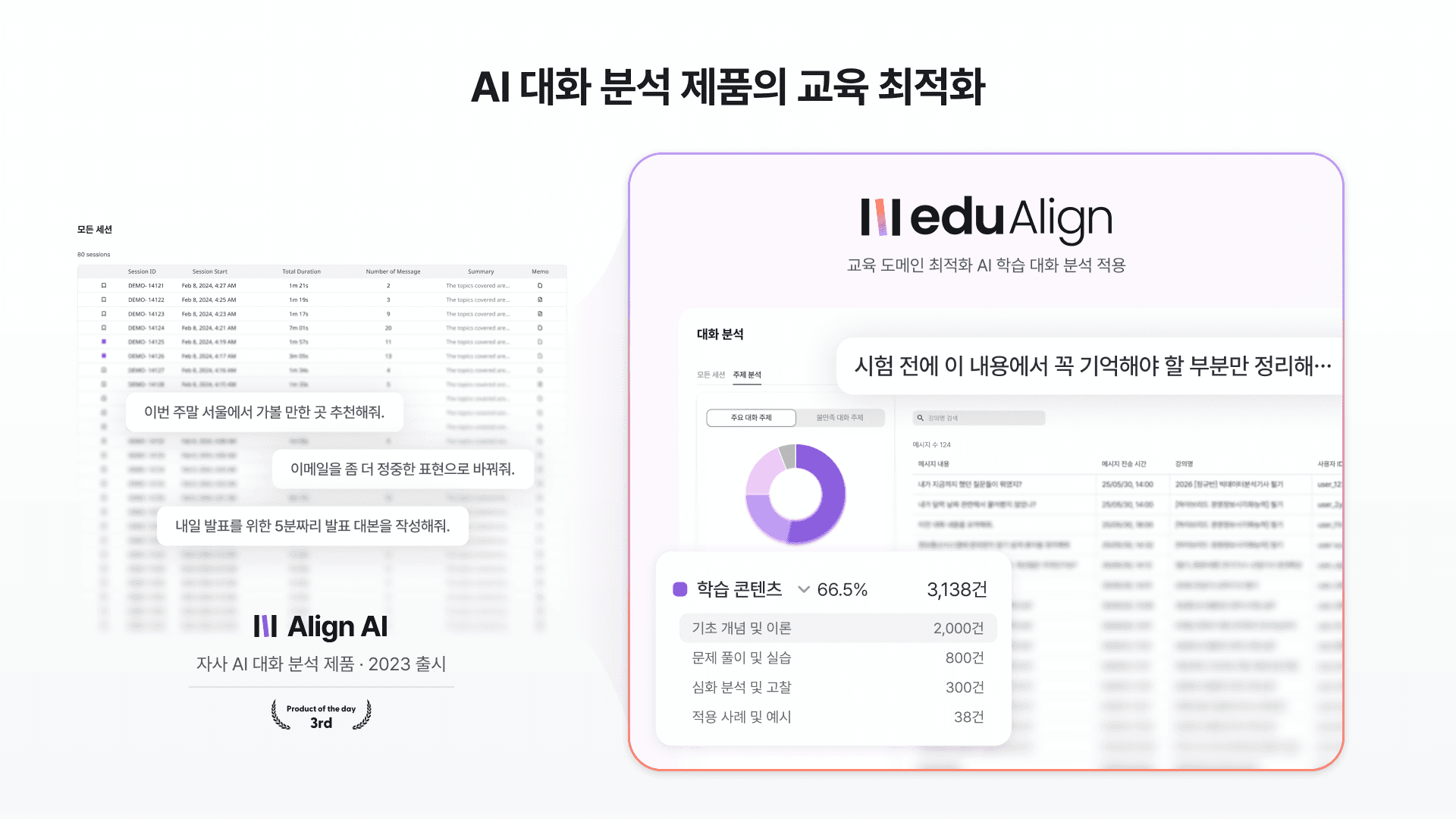
Align's dialogue analysis technology meets education
eduAlign is not a product that started anew in a completely different place from Align. It is a service that extends the dialogue analysis technology and experience accumulated in Align to fit the new context of education. The technology that analyzed user dialogues in general-purpose AI services is now evolving into technology that understands learners' dialogues and behaviors in educational environments.
Rather than simply measuring the volume of dialogue,
In which lectures the AI tutor is utilized
What learners are asking
What learning topics are repeated
What content is used in actual learning
What difficulties occur in the learning process
are viewed from the perspective of education.
And dialogue shows the 'context of learning'.
For example, if learners who used the AI tutor in lecture A also frequently use the AI tutor in lecture B, this data is not a simple usage record. It can be a learning pattern showing that a learner who took lecture A is likely to study lecture B next. By analyzing the usage data of learners with similar learning paths, and looking together at content information such as lecture categories and descriptions, we can also answer the question, "What lecture would this learner be interested in next?"
In this way, eduAlign interprets dialogue and behavioral data in the context of learning and discovers new insights within it.
From Dialogue Analysis to Education Analysis
What Align taught us was that dialogue contains a lot of information that can help us understand users. And as it met education, we began to look at that fact in a new way. Dialogue contains learners' worries, questions contain learners' difficulties, and dialogue patterns contain the process of learning.
So now, we do not view dialogue as simple text data. We look at it as data to understand learning.
When Dialogue Analysis Meets Education
Just because two different areas meet does not mean that something completely new is created. When new context is added to existing technology and experience, possibilities that were not visible before begin to appear. Just as Align's dialogue analysis technology met education and became eduAlign. Moving forward, eduAlign aims to develop into an education-specialized dialogue analysis service that understands learners' dialogues and behaviors more deeply, and creates better learning experiences based on that data.
From technology that understands dialogue, to technology that understands learning.
Align × Education = eduAlign